Covering it up and treating it are two different things.
A fan hides the sound while it is playing. Turn it off and the ringing is exactly as loud as it was. Nothing was treated.
Treble Health® Clinical Team8 minute read
Tonight, when the fan is on and you are almost asleep, turn it off for ten seconds. The ringing will be exactly as loud as it was before you turned the fan on. Not louder because you are tired. Not quieter because the fan helped. Exactly the same.
That is not a failure of the fan. The fan did the only thing it was ever built to do, which is cover the sound while it is playing. Covering something and treating it are two different things, and most people with tinnitus have only ever been offered one of them.
If the fan, the app, or the sound machine is what got you through the last few years, it earned its place. The problem is not that you reached for it. The problem is that nobody ever handed you a second option.
“I don’t want it masked”
“I don’t want it masked. I don’t want it covered up with other noise. I just want it GONE. I want to hear silence!!!”
“I use the crickets, evening crickets to shade it. But I mean, if I’m at a meeting, I can’t be playing my crickets out loud.”
Masking works where you control the room. It stops working at a meeting, at dinner, in a quiet car. Most people end up shortening the list of places they are willing to go, and they rarely notice they are doing it. The dinner invitation gets declined because the restaurant is loud, or because it is quiet, and either reason is really the same reason.
The second problem with masking is that it has no memory. Every night starts at zero. Nothing accumulates. Six years of sound machines leaves you exactly where six weeks of sound machines left you, which is a strange thing to say about a treatment and a very ordinary thing to say about a curtain.
What about hearing aids?
Patients ask this constantly, and it is a reasonable question rather than a naive one. Hearing aids sometimes do help with tinnitus, particularly when the tinnitus sits alongside hearing loss, and clinical guidance supports trying amplification for that reason. Many people notice the ringing recedes somewhat once the missing input is restored during the day.
The distinction worth holding onto is what they were designed to do. Hearing aids were built to restore input. They amplify what is around you so your auditory system receives more of what it has been missing. That is a genuine benefit, and for someone with hearing loss it is often the right first step regardless of the tinnitus.
But restoring input and treating tinnitus are not the same job, and doing the first does not automatically accomplish the second. Some people with hearing aids get real relief. Others wear them faithfully, hear better, and still hear the ringing exactly as they did before. Neither outcome means anyone did anything wrong.
The question worth asking of anything you are offered
Masking and amplification both manage the sound in the moment. One covers it while it plays, the other changes what else is reaching you while you are wearing it. Both can make a day more livable, and neither is a mistake.
So the question worth asking of anything you are offered is simply this. Is anything different when nothing is playing? That single question sorts almost everything in this category, and it is the one most people are never invited to ask.
A different category of thing
A treatment aimed at the brain is a different kind of proposition. Instead of covering the signal or feeding more sound in around it, the goal is to change how the circuit that produces the signal behaves, which is why those approaches are scheduled over weeks rather than switched on when the room goes quiet. If you want the mechanism itself, in plain language, we wrote it up separately in why the sound is generated in the brain rather than the ears.
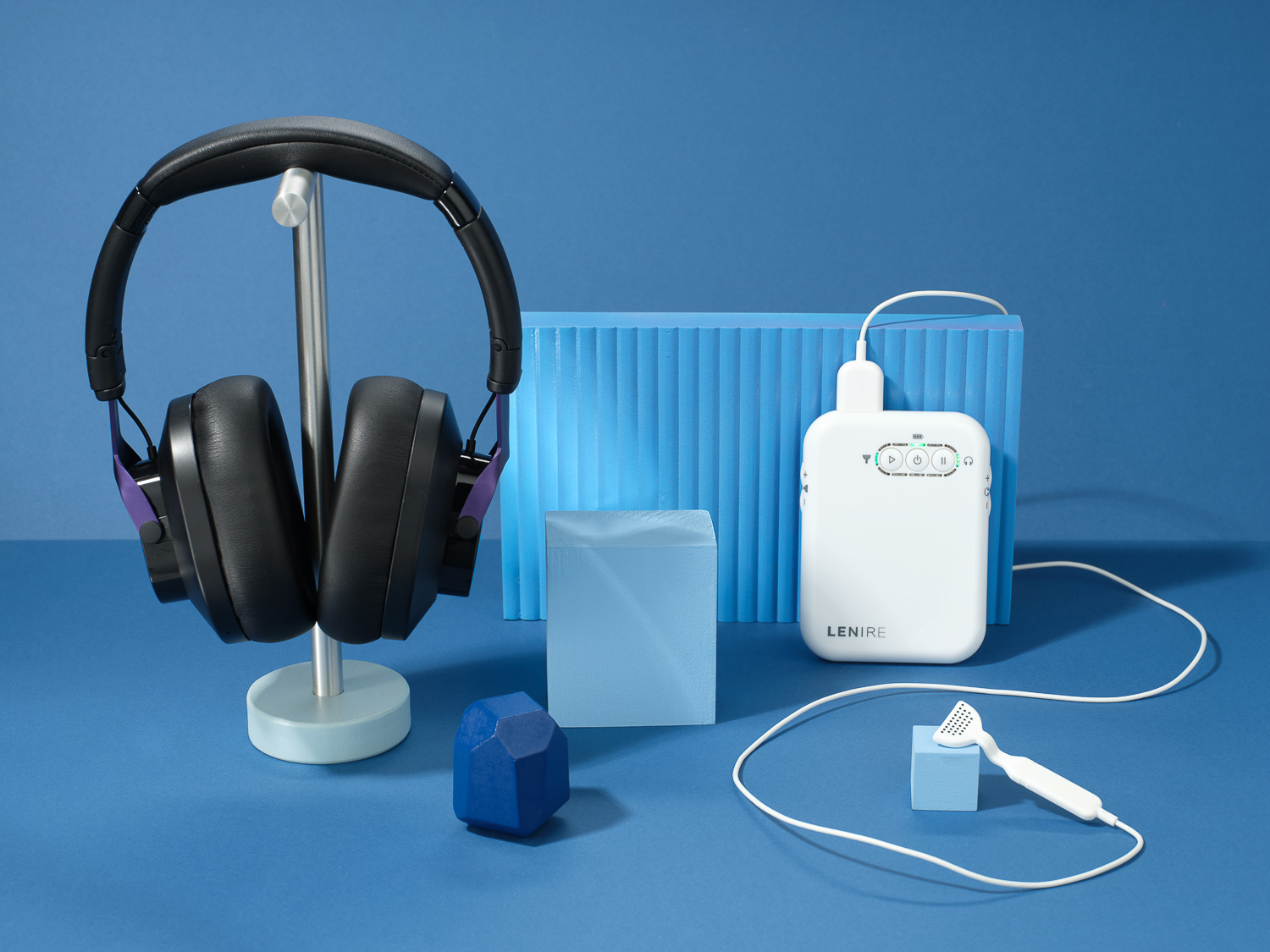
Lenire® is one device in that category. It is a prescription medical device that pairs sound through headphones with a mild electrical pulse on the tip of the tongue, used twice a day for thirty minutes a session. It was granted De Novo authorization by the FDA in March 2023, and the authorized indication is to temporarily relieve the symptoms of tinnitus in adults 18 and over whose tinnitus is at least moderate.
What the evidence actually shows
In the trial that supported the FDA submission, patients spent six weeks on sound-only stimulation before tongue stimulation was added. Among the patients with moderate or worse tinnitus who did not respond to those first six weeks of sound alone, 70.5% went on to respond once tongue stimulation was added. That was 44 patients, with response defined as a 7-point or greater improvement on the Tinnitus Handicap Inventory. Published in Nature Communications in 2024.
Read that design carefully, because it is unusual and it matters. The comparison was not device against nothing. Everyone in that group had already put in six weeks of sound stimulation and had already failed to improve on it. The only thing that changed was the addition of the second input.
In other words, the group it helped most in that comparison was the group sound alone had already failed. If you are someone for whom sound therapy did not do very much, that is the population this result speaks to, not an argument against you.
It is also worth being straight about what these trials were and were not. None of them had a sham arm and none was fully blinded, which is why careful clinicians describe what was measured rather than reaching for a phrase like clinically proven.
The people who would actually treat you
Most audiologists see a tinnitus patient a few times a month, between hearing aid fittings and wax removal. At Treble Health®, tinnitus is the entire practice. That is not a claim about talent. It is a claim about repetition, and repetition is what you want in a condition this variable.
Dr. Ben Thompson, AuD
Doctor of Audiology · Founder, Treble Health®
Doctor of Audiology and founder of Treble Health in 2020, previously at UCSF Medical Center. He holds a certificate of competence in Tinnitus Retraining Therapy and has published more than 100 educational videos to an audience of over 100,000 subscribers.
Dr. Garrett Thompson, AuD
Doctor of Audiology
Doctor of Audiology who has been serving patients with hearing loss since 2013. He spent five years in private practice on the Upper East Side of Manhattan before joining Treble Health®.
Dr. Kristen Barton, AuD
Doctor of Audiology · Lenire-certified
Doctor of Audiology with more than five years in tinnitus care, who completed her externship at the Rocky Mountain Regional VA Medical Center. She is certified to fit and program Lenire.
Dr. Tyler Ellis, AuD
Doctor of Audiology · Lenire-certified
Doctor of Audiology with seven years in tinnitus and hyperacusis care. He fits prescription hearing aids and sound therapy devices, including the Neuromod Lenire.
What the founder says about it
“Lenire is the most researched tinnitus device available, backed by multiple independent studies. It is not a cure, and it is not right for everyone. But when it is fitted correctly and matched to the right patient, it can make a real difference. The best results come when the device is part of a comprehensive program led by a tinnitus specialist.”
Dr. Ben Thompson, AuD, founder of Treble Health®
What actually happens if it is a fit
Most people arrive with a drawer. A sound machine, an app, a bottle of something from the pharmacy, a printout from a second opinion. Every one of those was a reasonable decision made in isolation. Nobody sequenced them, nobody measured whether any of them moved anything, and nobody owned the outcome. That is the difference between having pieces and having a plan.
Here is what the sequence looks like at Treble Health®.
A consultation, online or by phone, with no commitment attached to it.
A 30 minute video call with your audiologist to go through your tinnitus history and whether Lenire® is right for you.
If it is a fit, you get a treatment plan and we walk you through what comes next. A recent audiogram, from within the last 12 months, is required before treatment begins. If you do not have one, the team helps you arrange a hearing test.
Your device is programmed by the audiology team before it ships, so it is ready to use when it arrives at your door.
A telehealth fitting appointment, then daily at-home use of two 30 minute sessions.
Eight 1:1 telehealth visits with your audiologist across a structured six month program. The minimum treatment protocol is 12 weeks.
Ongoing device support from the audiology team, including reprogramming if your settings need to change.
Care is delivered by secure telehealth in the states where the audiologists are licensed, which means the person who programs your device is the same person who sees you through the months that follow. That continuity is not a convenience feature. It is how the settings get corrected when something is not working.
Talk to an audiologist who works on tinnitus and nothing else.
It is a 30 minute telehealth conversation. You go through your case history with a Doctor of Audiology, and you get an honest answer about whether Lenire® is a fit for you. There is no cost for the conversation.