The sound is not being made where you think it is. That single fact explains why almost everything you have put in your ears has disappointed you.
Treble Health® Clinical Team8 minute read
Why would a medical device touch your tongue to treat a sound in your ears? It is a fair question, and the answer is the single most useful thing most people with tinnitus have never been told. The sound is not being made in your ears.
So where is the sound actually coming from?
The ear is usually where the input stopped, not where the sound is made. When the auditory system stops receiving the input it expects, the brain compensates by turning up the sensitivity of the neurons that were listening for it. Turned up far enough, that circuit starts producing a signal on its own. That signal is what you hear.
It helps to think about what the auditory system is actually doing all day. It is not a microphone. It is a prediction machine, constantly comparing what it expects to hear against what arrives, and adjusting its own gain to keep the picture usable. Noise exposure, age, an ear infection, a single loud event, or ototoxic medication can quietly remove a narrow band of input. The gain on that band goes up to compensate. The neurons in that band start firing more readily, more synchronously, and eventually without any input at all.
That is also why the pitch of your tinnitus often sits close to the region where your hearing has changed, and why two people with the same audiogram can describe completely different sounds. The signal is generated by a circuit, and circuits differ.
Clinicians often reach for phantom limb to explain it. People who lose a limb frequently still feel it, sometimes vividly, sometimes painfully. The limb is gone. The sensation is real, and it is generated further up. Tinnitus is the same phenomenon in the auditory system.
This does not mean your tinnitus is imagined, psychological, or all in your head. The brain is generating a real signal, and you are really hearing it. Anyone who has told you otherwise was describing their own uncertainty, not your condition.
It is also why treatments aimed at the ear keep disappointing people. If the signal is being generated further up, something you put in your ear was never addressing where the problem actually lives. The same logic explains why the supplement aisle has such a poor record here. The clinical practice guideline from the American Academy of Otolaryngology–Head and Neck Surgery Foundation recommends against ginkgo biloba, zinc, and melatonin for treating tinnitus. Not because supplements are absurd, but because a capsule has no way to reach a gain-control problem in a sensory circuit.
What that means a real treatment has to do
If the brain is producing the signal, then a treatment has to change how the brain processes it, rather than cover it while it plays. The test of whether something treated it instead of hiding it is simple. Is anything different when nothing is playing?
There is a well-established way to nudge a sensory circuit, and it is not volume. It is pairing. When two inputs arrive together, repeatedly and with reliable timing, the connections that carry them adjust. This is the basic mechanism behind a great deal of neurological rehabilitation, and it is the reason therapies for the brain tend to be scheduled rather than swallowed. They require repetition on a clock.
That is a genuinely different register from anything a sound machine can offer, and it also sets a fair expectation. A treatment that works by repetition is not going to do anything impressive on the first evening. It asks for weeks.
Where Lenire® comes in
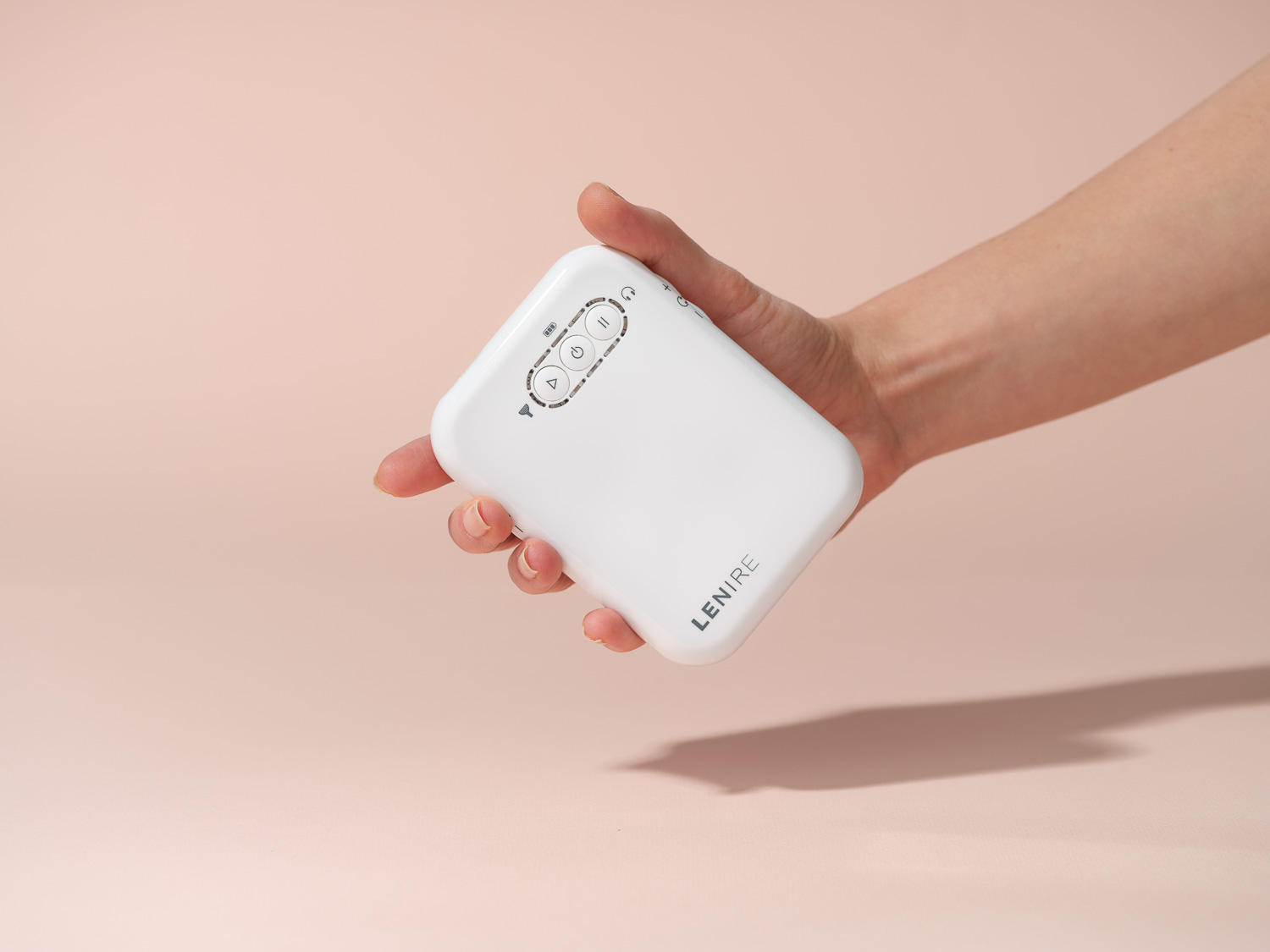
Lenire is a prescription medical device that uses bimodal neuromodulation. Sound is delivered through a pair of Bluetooth headphones, and paired with it is a small tongue tip that rests on the tip of the tongue and delivers a mild, gentle electrical pulse through an array of electrodes. The two are used together, twice a day, thirty minutes a session.
The tongue is used because it is densely innervated and easy to reach non-invasively, and because its signals reach the same brainstem circuitry that auditory signals pass through. That shared route is what makes pairing the two inputs possible in the first place.
Pairing is what is thought to drive the change in how the brain responds. The auditory signal and the signal from the tongue arrive together, on a timing pattern set by the device, and that combination targets the mechanism described above rather than the ear. In practice it looks unremarkable. You sit down, put on the headphones, hold the controller, and use it for two 30 minute sessions at home, typically one in the morning and one in the evening.
It was granted De Novo authorization by the FDA in March 2023.
Who this is for
Lenire® was studied in, and is authorized for, adults 18 and over whose tinnitus is at least moderate. That means people whose tinnitus is genuinely disrupting sleep, concentration, or quiet moments, not people who notice a faint ring occasionally in a silent room. If tinnitus has changed how you live, you are the person this was built for.
It is a prescription device, self-administered at home following prescription by a clinician experienced in tinnitus. The authorized indication is to temporarily relieve the symptoms of tinnitus, and that wording is deliberate. It describes a treatment that is worked at, not a switch.
Severity here is not a matter of opinion. It is measured, usually with the Tinnitus Handicap Inventory, which is the same instrument the research uses. That is part of why candidacy gets decided in a conversation with a clinician rather than by a quiz on a website.
What the evidence actually shows
In the trial that supported the FDA submission, patients spent six weeks on sound-only stimulation before tongue stimulation was added. Among the patients with moderate or worse tinnitus who did not respond to those first six weeks of sound alone, 70.5% went on to respond once tongue stimulation was added. That was 44 patients, with response defined as a 7-point or greater improvement on the Tinnitus Handicap Inventory. Published in Nature Communications in 2024.
Read that design carefully, because it is unusual and it matters. The comparison was not device against nothing. Everyone in that group had already put in six weeks of sound stimulation and had already failed to improve on it. The only thing that changed was the addition of the second input.
In other words, the group it helped most in that comparison was the group sound alone had already failed. If you are someone for whom sound therapy did not do very much, that is the population this result speaks to, not an argument against you.
It is also worth being straight about what these trials were and were not. None of them had a sham arm and none was fully blinded, which is why careful clinicians describe what was measured rather than reaching for a phrase like clinically proven. What was measured is a consistent, repeated improvement in the group this article is about.
The people who would actually treat you
Most audiologists see a tinnitus patient a few times a month, between hearing aid fittings and wax removal. At Treble Health®, tinnitus is the entire practice. That is not a claim about talent. It is a claim about repetition, and repetition is what you want in a condition this variable.
Dr. Ben Thompson, AuD
Doctor of Audiology · Founder, Treble Health®
Doctor of Audiology and founder of Treble Health in 2020, previously at UCSF Medical Center. He holds a certificate of competence in Tinnitus Retraining Therapy and has published more than 100 educational videos to an audience of over 100,000 subscribers.
Dr. Garrett Thompson, AuD
Doctor of Audiology
Doctor of Audiology who has been serving patients with hearing loss since 2013. He spent five years in private practice on the Upper East Side of Manhattan before joining Treble Health®.
Dr. Kristen Barton, AuD
Doctor of Audiology · Lenire-certified
Doctor of Audiology with more than five years in tinnitus care, who completed her externship at the Rocky Mountain Regional VA Medical Center. She is certified to fit and program Lenire.
Dr. Tyler Ellis, AuD
Doctor of Audiology · Lenire-certified
Doctor of Audiology with seven years in tinnitus and hyperacusis care. He fits prescription hearing aids and sound therapy devices, including the Neuromod Lenire.
What the founder says about it
“Lenire is the most researched tinnitus device available, backed by multiple independent studies. It is not a cure, and it is not right for everyone. But when it is fitted correctly and matched to the right patient, it can make a real difference. The best results come when the device is part of a comprehensive program led by a tinnitus specialist.”
Dr. Ben Thompson, AuD, founder of Treble Health®
The last sentence is the one people skip. A device that works by repetition needs someone watching the repetition, adjusting the settings, and deciding what to change when a week goes badly. Handed over in a box with a manual, it is a piece of hardware. Inside a program, it is a treatment.
What actually happens if it is a fit
Most people arrive with a drawer. A sound machine, an app, a bottle of something from the pharmacy, a printout from a second opinion. Every one of those was a reasonable decision made in isolation. Nobody sequenced them, nobody measured whether any of them moved anything, and nobody owned the outcome. That is the difference between having pieces and having a plan.
Here is what the sequence looks like at Treble Health®.
A consultation, online or by phone, with no commitment attached to it.
A 30 minute video call with your audiologist to go through your tinnitus history and whether Lenire® is right for you.
If it is a fit, you get a treatment plan and we walk you through what comes next. A recent audiogram, from within the last 12 months, is required before treatment begins. If you do not have one, the team helps you arrange a hearing test.
Your device is programmed by the audiology team before it ships, so it is ready to use when it arrives at your door.
A telehealth fitting appointment, then daily at-home use of two 30 minute sessions.
Eight 1:1 telehealth visits with your audiologist across a structured six month program. The minimum treatment protocol is 12 weeks.
Ongoing device support from the audiology team, including reprogramming if your settings need to change.
Care is delivered by secure telehealth in the states where the audiologists are licensed, which means the person who programs your device is the same person who sees you through the months that follow. That continuity is not a convenience feature. It is how the settings get corrected when something is not working.
How to find out whether you are a candidate
Candidacy is a clinical question, not a quiz. It depends on how much the tinnitus is actually disrupting your life, measured properly, and on a recent hearing test.
The way to answer it is a conversation with an audiologist who works on tinnitus specifically, rather than as one condition among many. That is the whole job at Treble Health®, and it is the difference between another opinion and an actual plan.
You have spent a long time managing this on your own, with the tools you were handed. The only thing being asked of you here is one conversation with someone who does this all day.
Talk to an audiologist who works on tinnitus and nothing else.
It is a 30 minute telehealth conversation. You go through your case history with a Doctor of Audiology, and you get an honest answer about whether Lenire® is a fit for you. There is no cost for the conversation.